
It is people, not laws, that drive privacy. In his second column of a series exploring “Privacy through Time and Space” Bailiwick Data Protection Commissioner Brent Homan relates stories shared with him by Alex White, a Queensland Australia Privacy Commissioner by day and Romanophile by night!
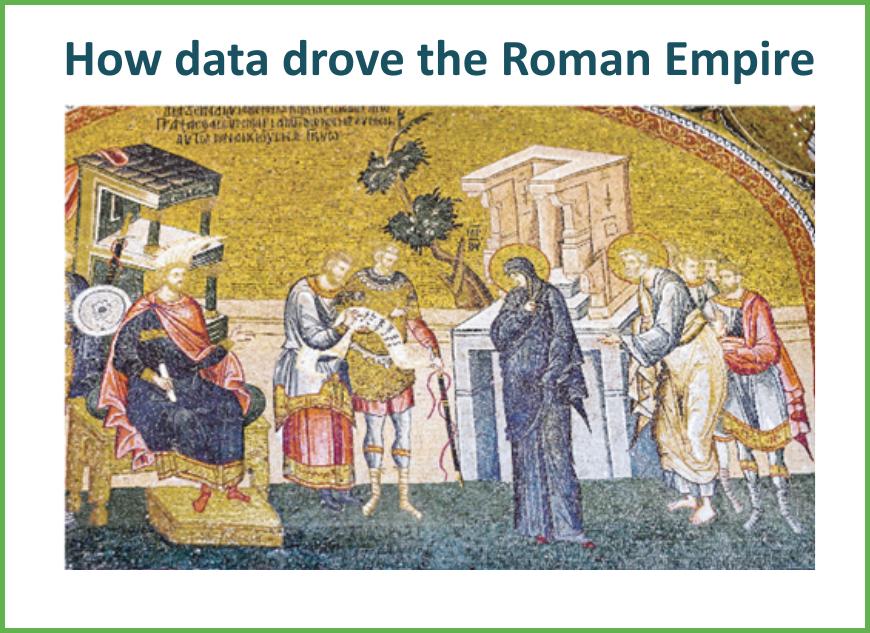
As AI pushes our digital era into hyper-drive we can be forgiven for thinking the use of data and information is a strictly ‘modern’ phenomenon. Well think again. Two thousand years ago, the Roman Empire was running one of the most sophisticated data operations in history —without a single line of code.
The Romans were one of the first civilizations to embrace an undeniable truth: information is power. Citizenship records weren’t just bureaucratic trivia; they were the gateway to rights. As a Roman citizen that could mean the right to own property, to excuse yourself from military service, or even to avoid torture. And to cite another axiom that transcends time and space - follow the money! Personal data underpinned Roman tax obligations and as with current times this could be progressive, including tax exemptions for citizens and incentives for military service, or regressive such as a poll tax on non-citizens.
But what is striking is just how familiar these ancient dynamics feel. The Romans were wrestling with identity verification, fraud prevention, and trust marks —but in a world without facial recognition or forgettable passwords requiring an upper case/lower case/number and #% Symbol. How did the Romans overcome these challenges? Community trust, seals, and witnesses. If you claimed citizenship on the road, you’d better speak Latin, dress the part, and know your patron’s name. Fraud was a crime punishable by death. That is quite the disincentive to impersonation isn’t it!?
The administrative centrepiece of Rome was the census. Citizens journeyed to census towns to register their name, age, property, and status. Miss the census voluntarily? You could be sold into slavery. The censors weren’t just bean counters; they were moral auditors, marking down extravagance, cruelty, even celibacy when marriage was “expected.” They tracked taxes on land, cattle, customs—and yes, even unmarried adults. If you think today’s regulators have reach, imagine one who could fine you for neglecting your fields.
Military service was another data-driven enterprise. A soldier’s entire career was etched onto a bronze diploma, sealed and witnessed, granting pensions and citizenship rights. These records were cross-checked against a central repository in Rome—a low-tech but highly effective version of today’s digital ledgers.
So what lessons can we draw from Rome’s analogue empire? First, trust remains the cornerstone. Whether wax seals or digital signatures, systems fail without confidence in authenticity. Second, proportionality matters. Romans debated who needed scrutiny and when—just as we balance privacy rights against civic protections today. And third, governance is not about who has the fanciest tech tools. It’s a dynamic responsibility about rule of law, chain of evidence, and clarity on who holds the keys.
So as the AI-driven tech cyclone re-shapes how we improve governance, let’s not forget Rome and what it teaches us about the fundamentals of data integrity. Who vouches for you? What seals do we trust? When do we centralize, and when do we distribute? The empire may have fallen, but its data lessons endure.